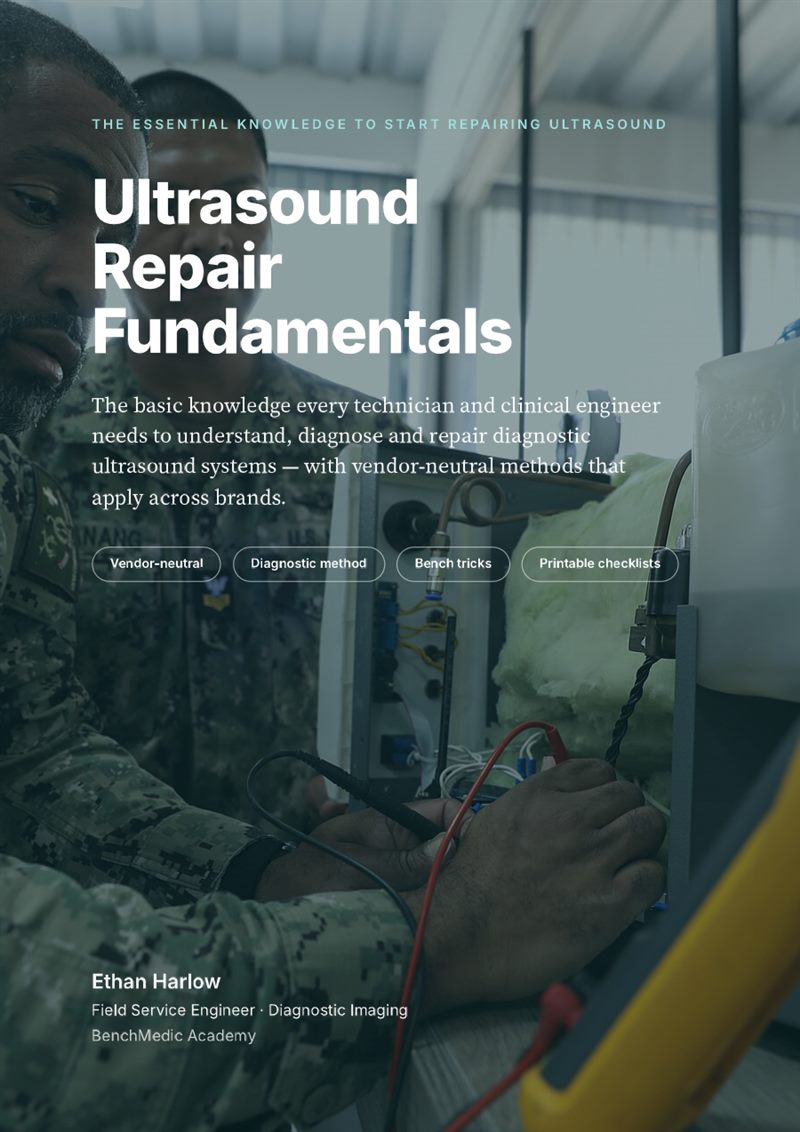
The basic knowledge every technician and clinical engineer needs to understand, diagnose and repair diagnostic ultrasound systems — with vendor-neutral methods that apply across brands.

Most ultrasound faults are familiar: a cracked lens, a broken conductor at the strain relief, a clogged filter, a drifting high-voltage supply, a misconfigured DICOM node. What separates a quick repair from days of part swapping is understanding how the system works and a structured way to isolate the fault.
Each chapter combines original diagrams, real photographs, reference tables and a summary of key points.
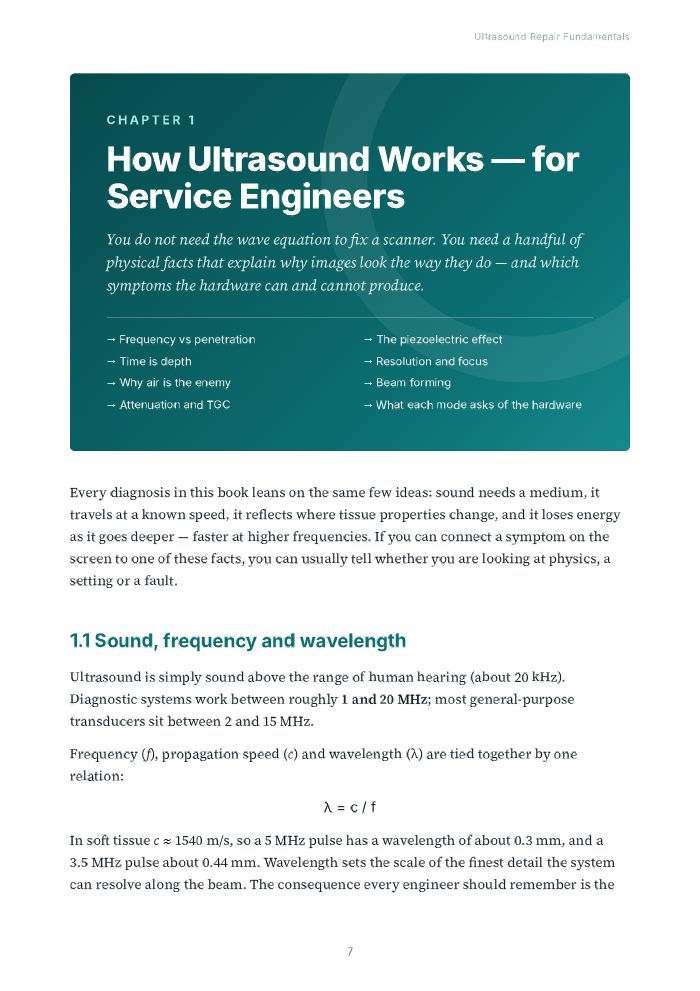
The physics needed to reason about faults: frequency, depth, impedance, attenuation, beam forming and imaging modes.
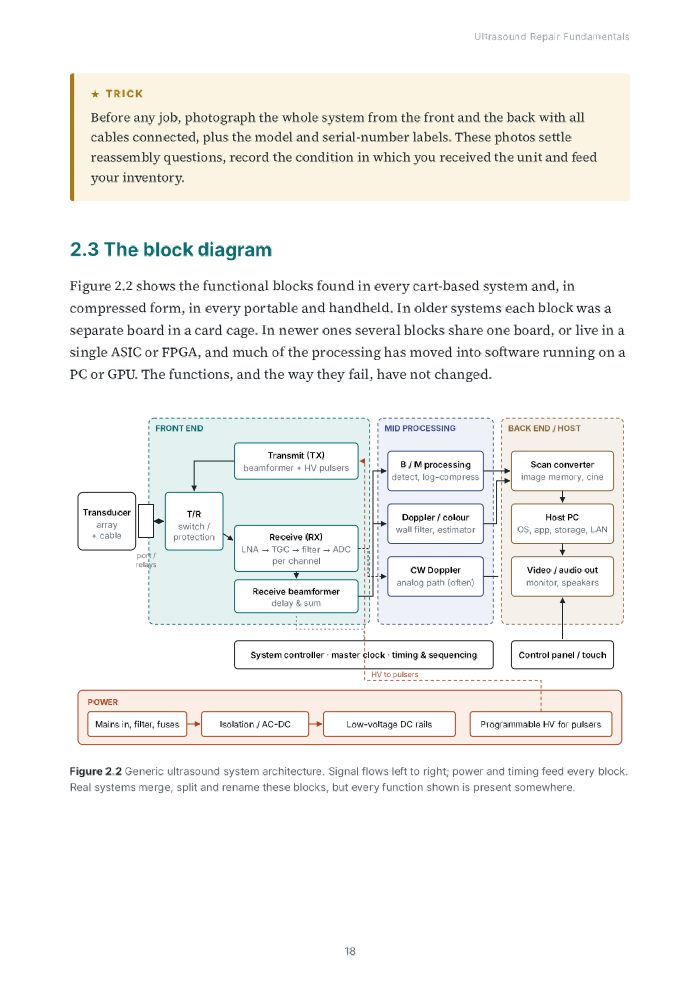
Equipment formats, external anatomy and a generic block diagram that applies across brands.
Construction, the six common failure points and six field tests, including the paper clip test.
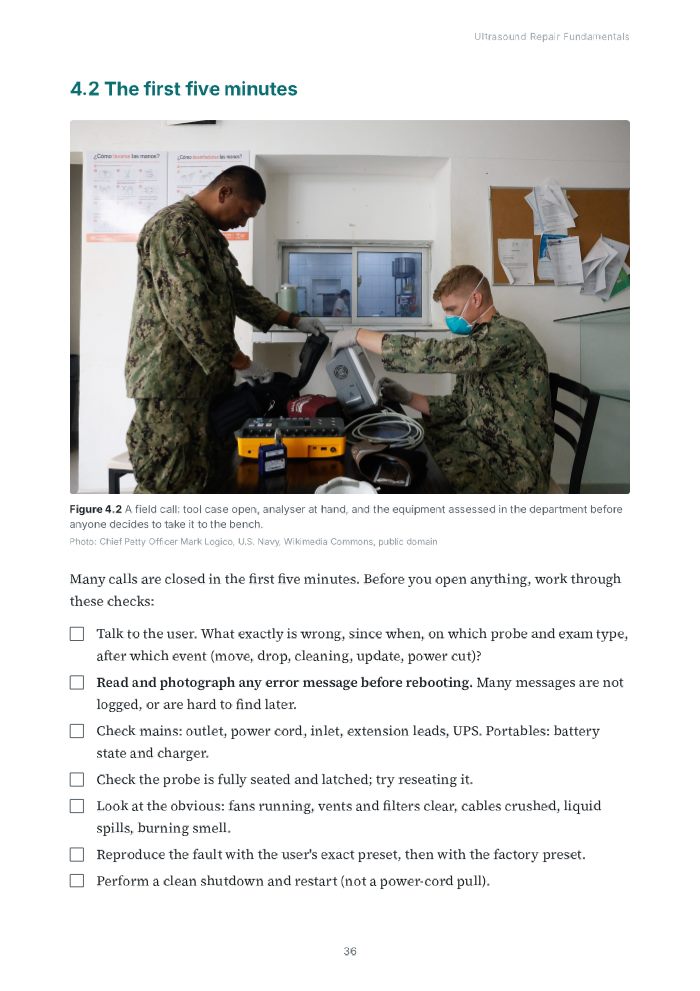
Probe or system, symptom-to-block tables, built-in diagnostics, board isolation and five case studies.
Shadowing, reverberation, aliasing, colour noise and the settings that imitate hardware faults.
Safe reinstallation, DICOM essentials and modality-to-PACS troubleshooting.
A software library, naming conventions, ISO images, licence keys and disk cloning.
DICOM, network and disk utilities, bench instruments and the field kit.
Electrical safety testing, ESD, preventive maintenance and phantom-based image QA.
What changes between brands, manufacturer profiles, portables and handhelds.
Tools, inventory and risk, repair-or-replace decisions, OEM relations and user training.
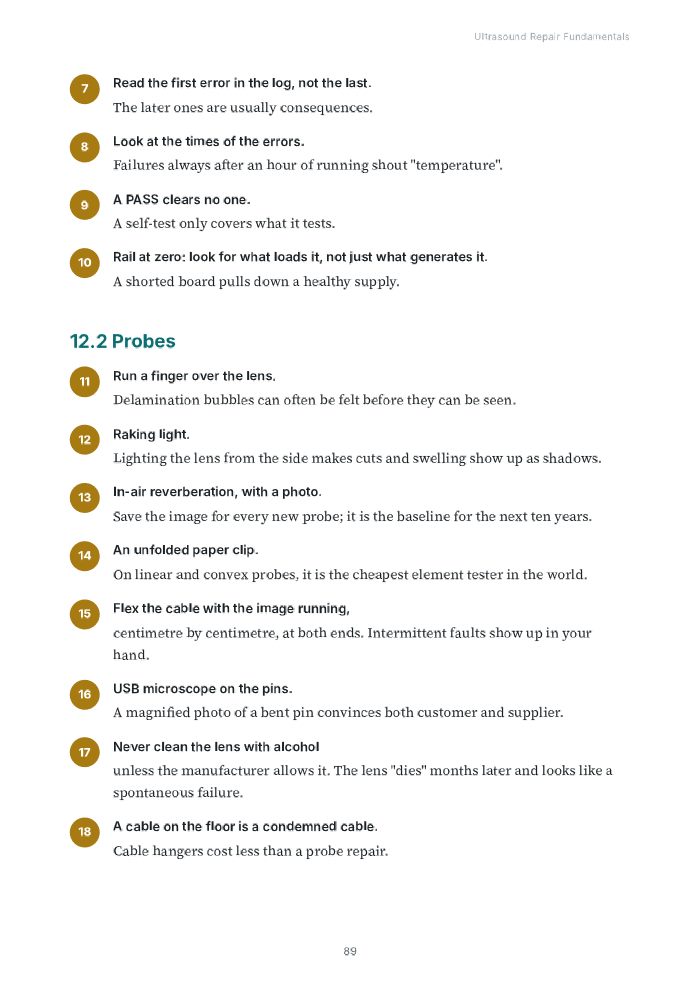
Fifty practical habits for diagnosis, probes, hardware, DICOM and service calls.
Appendices: quick-reference fault tables, printable checklists and forms, glossary, further reading and image credits.
Large, comfortable type, consistent layout and illustrations that support the text.
PM checklist, transducer inspection record, fault report, configuration sheet and post-repair release checklist, as printable pages.
Image symptoms and system behaviour mapped to the most likely cause and the section that explains it.
Corrections and improvements to this edition are provided to buyers at no extra cost.
One-time payment. Instant download after purchase. Secure checkout by Hotmart in your local currency.
E-book in PDF, for individual use.
If the book does not meet your expectations, you can request a full refund through Hotmart within 7 days of purchase.
English only. The e-book is published in English and there is no translated edition. The text uses clear technical English with short sentences, diagrams and tables. If you are browsing a translated version of this site, only the website is translated — not the book.
It teaches principles, architecture and methods that apply to diagnostic ultrasound in general, and includes a chapter on what changes between the major manufacturers. It is not a service manual for any specific model.
No. Basic electronics knowledge helps, but the book starts from the physics you need and builds up to fault isolation. Experienced technicians use it to standardise their method and train new team members.
No. It contains no proprietary or confidential manufacturer information. It helps you use the manufacturer's documentation and tools more effectively.
Immediately after payment, Hotmart sends you access to download the PDF. You can read it on any device or print it.
Yes. The Hotmart checkout displays the price in your local currency and accepts international cards.
The e-book is licensed for individual use. For a team licence, contact us at contact@benchmedicacademy.com.
You can request a full refund through Hotmart within 7 days of purchase.
In English · 105 pages · 12 chapters · 5 appendices · US$ 27 at launch
Buy the e-book